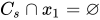
Si imprimes esta página, o eliges la opción de Vista preliminar de impresión de tu navegador, verás que desaparecen este cuadro y los elementos de navegación de arriba y de la izquierda, pues no son útiles en una versión impresa.
Pulsando antes en Refrescar esta página te asegurarás de obtener los últimos cambios del libro antes de imprimirlo.
En la introducción, o en algún lugar especial, de los libros de la teoría axiomática de conjuntos suele darse una explicación de por qué es necesario fundamentar la teoría de conjuntos y dejarla construida a partir de unos cuantos axiomas. Estos axiomas son, en su mayoría, principios evidentes de por sí una vez que se ha comprendido previamente como deben comportarse los conjuntos o, por lo menos, cuando ya se tiene una idea de esto. Por esa razón, es más que justificable la revisión de una exposición intuitiva de la teoría de conjuntos, como el que incluimos aquí, en donde se expongan unas cuantas cosas, de forma rápida e intuitiva, que familiaricen al lector con los conjuntos, sus relaciones y operaciones; de esta manera el lector no encontrará (esperamos) dificultades mayores a la hora de enfrentarse a la teoría axiomática de conjuntos, donde los principios de los que se parte son formalizaciones y restricciones ad hoc de las propiedades que uno ya le suponía a los conjuntos.
Lo principal para nuestro desarrollo de la teoría (intuitiva) de conjuntos es aceptar que es posible ‘comprimir’ o ‘substancializar’ una colección o conjunto (que para este caso son lo mismo) de cualesquiera objetos diferentes y, así, poder considerarla como un todo o, mejor dicho, como una única cosa que tratar. Los objetos de un conjunto se llaman elementos de dicho conjunto.
1.1.1. Desde luego, la relación más básica de la teoría de conjuntos es la que existe entre los elementos y su conjunto: la relación de pertenencia. Como es la regla hoy en día, escribiremos
para indicar que el objeto es uno de los elementos del conjunto . Es decir, el símbolo "", una versión de la letra griega (épsilon), lo usaremos para representar la relación de pertenencia[1]. Los argumentos de una relación son los objetos que acompañan a esa relación. En el ejemplo , los argumentos de la relación son (primer argumento) y (segundo argumento). Así, puede decirse que los primeros argumentos de la relación pertenecen al universo de los elementos, mientras que los segundos argumentos de esta misma relación pertenecen al universo de los conjuntos. Si aceptamos que todo es un conjunto (algo que, por ciertas razones que se verán en su momento, haremos cuando se desarrolle la teoría axiomática de conjuntos), entonces los primeros y segundos argumentos de pertenecen al mismo universo.
La negación de la escribiremos
.
Ejemplo:
Consideremos el conjunto . Con esto lo que estamos haciendo es denominar por al conjunto . Pues bien, podemos decir entonces que y que .
1.1.2. Diremos que dos conjuntos e son iguales, lo que se representa por , si y solo si e consisten de los mismos elementos. Así pues, siempre que
si y solo si
para todo elemento (i.e. si todo elemento de es elemento de y, recíprocamente, si todo elemento de es elemento de ).
Ejemplo: Siguiendo con nuestro ejemplo, según nuestro criterio vemos que . En efecto, cada uno de los elementos del conjunto de la izquierda es un elemento del conjunto de la derecha, y viceversa. Podemos pues considerar que ambos conjuntos son iguales, y, como hicimos antes, podemos identificar entonces como a cualquiera de ambos.
1.1.3. Por otra parte, como un hecho más general que la igualdad, un conjunto es subconjunto de otro , lo que se representa por
,
siempre que
implica
para cualquiera que sea el elemento (i.e., si todo elemento de es elemento de ). Claramente
para todo conjunto , por lo que se dice que la relación es reflexiva. También tenemos que
y si y solo si ,
y que
y implica
para cualesquiera conjuntos , y . Estos dos hechos muestran, respectivamente, que la relación es antisimétrica y transitiva (véase más adelante relaciones).
1.1.4. Si y (i.e. si tiene por lo menos un elemento más que ) se dice que es subconjunto propio de , lo cual se representa por
.
^ Peano fue el primero en representar la relación de pertenencia por la letra en sus Arithmetices Principia (1889), por ser la primera letra de la palabra griega , que significa "está".
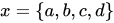
1.2.1. Si es un conjunto cuyos elementos son y solo ellos, es común representar a este conjunto por extensión
,
si (al que llamaremos cardinalidad) no es un número muy grande.
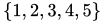
Por ejemplo representa por extensión el conjunto de las vocales del español y su cardinalidad es 5.
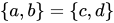
Tenga en cuenta que en un conjunto no hay elementos repetidos, por ejemplo el conjunto es el mismo conjunto
1.2.2. Nótese que, de acuerdo con esa notación,
es equivalente a .
1.2.3. Existe otra forma común de representar conjuntos, llamada por comprensión. Si es el conjunto de todos aquellos elementos que verifican una propiedad , entonces se representa también por
.
1.2.4. Así, si es la propiedad , entonces el conjunto
claramente contiene cualquier cosa.
1.2.5. Mientras tanto, si es la propiedad , entonces el conjunto
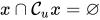
no contiene nada. Este conjunto sin elementos lo llamaremos conjunto vacío, y lo representaremos por . Tenemos que Error al representar (SVG (MathML puede ser habilitado mediante un plugin de navegador): respuesta no válida («Math extension cannot connect to Restbase.») del servidor «http://localhost:6011/es.wikibooks.org/v1/»:): {\displaystyle \varnothing\subseteq x}
para cualquiera que sea el conjunto (pues esto sería falso sólo si existiera algún elemento en que no estuviera en el conjunto , lo cual es absurdo pues no contiene nada).
Por otro lado,
implica
para cualquier conjunto . Efectivamente, pues si fuera y , entonces tendría por lo menos un elemento que no está en , lo que es imposible.
1.3.1. Las operaciones entre conjuntos consisten en tomar ciertos elementos de uno y ciertos de otro para formar con ellos nuevos conjuntos. Así, por ejemplo, si e son dos conjuntos, la unión de e es el conjunto
o .
Esto es, consiste de todos los elementos que están ya sea en , ya sea en , ya sea en ambos e . La unión se representa por el área sombreada en el diagrama siguiente:
Sean , y conjuntos cualesquiera. Se cumplen las propiedades siguientes:
( U-1 ) (idempotencia)
( U-2 ) (identidad)
( U-3 ) (conmutatividad)
( U-4 ) (asociatividad)
( U-5 )
( U-6 ) si y solo si
Estas propiedades son fácilmente demostrables. Veamos la demostración de ( U-2 ) y ( U-6 ):
( U-2 ) Hay que demostrar que todo elemento de es elemento de (demostrar que ) y que, recíprocamente, todo elemento de es elemento de (demostrar que ). Si , entonces o , de lo que solo puede ser . Recíprocamente, si , entonces . Por tanto .
( U-6 ) Supóngase que pero que . Entonces, en particular, existe tal que , pero si esto es cierto, , lo que contradice el hecho de que . Recíprocamente, si , entonces de ( U-5 ) se sigue el resultado deseado.
1.3.2. La intersección de dos conjuntos e se define como el conjunto
.
Es decir, es el conjunto formado por todos los elementos que están tanto en como en . La intersección se representa por el área sombreada en el diagrama siguiente :
Sean , y conjuntos cualesquiera
( I-1 ) (idempotencia)
( I-2 )
( I-3 ) (conmutatividad)
( I-4 ) (asociatividad)
( I-5 )
( I-6 ) si y solo si
Además, se cumplen las siguientes leyes distributivas:
( UI-1 )
( UI-2 )
1.3.3. Si e son dos conjuntos tales que (i.e. si e no tienen elementos en común) se dice que e son conjuntos disjuntos.
1.3.4. Las operaciones de unión e intersección pueden generalizarse. Si es una colección (conjunto) de conjuntos, la unión de los conjuntos de puede definirse como el conjunto
.
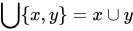
Así, si y solo si existe por lo menos un conjunto en que contenga al elemento . Como caso particular, tenemos
.
1.3.5. De manera similar, la intersección de los conjuntos de una colección se define por
.
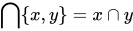
Por tanto, si para todo conjunto de (i.e. consiste de los elementos que están en todo conjunto de ). Como caso particular, tenemos
.
1.3.6. Nótese que, de acuerdo a la definición anterior, si , entonces, puesto que en ese caso implica para cualquiera que sea el conjunto y el elemento , el conjunto lo contiene todo.
1.5.1. Un conjunto muy importante en la teoría de conjuntos es aquel que, dado un conjunto cualquiera, contiene todos los subconjuntos de este conjunto . Un conjunto así se llama conjunto potencia. Más exactamente, si es un conjunto, entonces el conjunto potencia de es el conjunto dado por
.
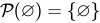
1.5.2. Puesto que , , y por tanto contiene un solo elemento, y por ello . Sea un conjunto con elementos. Entonces, existen subconjuntos de con un solo elemento, subconjuntos de con dos elementos, subconjuntos de con 3 elementos, y así sucesivamente hasta llegar a los subconjuntos de con elementos. De este modo, tiene
elementos, siendo esta última ecuación un caso particular del binomio de Newton. Como puede verse, el conjunto potencia de un conjunto contiene en general muchos más elementos que el conjunto , razón por la cual es difícil dar ejemplos de conjuntos potencia.
1.5.3. Nótese que equivale a .
1.5.4. Algo más interesante y conveniente de notar es que
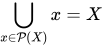
para cualquier conjunto . En efecto, pues de , se sigue para algún , es decir, para algún , por lo que . Recíprocamente, si , entonces para algún conjunto (e.g. el conjunto ), luego .
1.5.5. Como hecho más general, si es una colección de subconjuntos de un conjunto , es decir si , entonces .
1.5.6. Ahora vamos a generalizar algunas leyes a cerca de la unión e intersección de conjuntos. Primero, considérese un conjunto dado , y luego considérese una colección de subconjuntos de . Fórmese la unión
,
un subconjunto de . El complemento
,
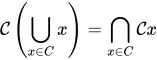
es un subconjunto de . Si , entonces , por lo que para todo , y puesto que , el complemento existe y para todo . Así, . El conjunto anterior es en efecto una intersección de los conjuntos de una colección, a saber
y .
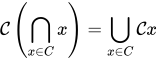
Sea un conjunto y una colección de subconjuntos de . El resultado anterior, y otro cuya demostración se deja como un sencillo ejercicio al lector, se presentan a continuación:
Las proposiciones anteriores son una generalización de las leyes de De Morgan.
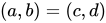
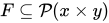
1.6.1. En matemáticas, un par ordenado es un par de objetos y tal que si es otro par ordenado, y serán iguales si y solo si y . La idea de esta descripción es garantizar que el orden de los componentes de un par ordenado importe. Sin embargo, no es sino en la teoría de conjuntos donde el concepto de par ordenado encuentra una definición al ser considerado como un tipo especial de conjunto que cumple lo que se acaba de describir del mismo. En realidad existen varias definiciones de par ordenado dentro de la teoría de conjuntos, aunque la más común, y la que usaremos aquí, es aquella donde el par ordenado se define por
para todo e Para ver que esta definición de par ordenado es adecuada, hemos de mostrar que
si y solo si y .
para cualesquiera , , , . Sea pues . Entonces
y o y .
Si , todo se reduce fácilmente a considerado que dos conjuntos son iguales si y solo si tienen los mismos elementos. Si , entonces no puede ser y , pues si resulta por definición de la igualdad de conjuntos, lo que contradice , y por tanto ha de ser y , con lo que claramente , además de que , pues suponer que nos lleva de nuevo a cuando la hipótesis dice lo contrario.
La definición de par ordenado anterior se debe a Kuratowski, quien la introdujo en 1921.
Ejercicio: Probar que es posible definir el par ordenado por
para todo e mostrando que en ese caso también se cumple
si y solo si y .
para cualesquiera , , y . Esta definición de par ordenado la dio Weiner en 1914.
Ejercicio: Considérese la definición de pares ordenados de Kuratowski. Probar que si y , entonces . Probar que, más generalmente, si y , entonces
1.6.2. La definición de par ordenado se puede generalizar inductivamente para cualquier número de componentes, mediante la ecuación
.
1.6.3. Sean e dos conjuntos. El producto cartesiano de e es el conjunto definido por
y .
Es decir, es el conjunto de todos los pares ordenados cuyo primer componente es un elemento de y segundo componente un elemento de .
1.7.1. Sean e dos conjuntos cualesquiera. Cualquier subconjunto del producto cartesiano que cumpla
( F-1 ) para todo existe tal que y
( F-2 ) y implica ,
se dice función de en . Para indicar que es una función de un conjunto en otro , es común escribir .
1.7.2. Sean dos conjuntos e , y sea una función de en . Si se dice que es antecedente de por medio de , y que es imagen de por medio de . Por definición, un elemento no puede tener ni más ni menos que una sola imagen , que representaremos por (de modo que si y solo si ). El conjunto se dice dominio de la función , y se representa comúnmente por , mientras que el subconjunto tal que para todo existe tal que (i.e. el subconjunto de que contiene solo las imágenes de los elementos de por medio de ) se dice rango de la función , y se representa por .
1.7.3. Claramente dos funciones y son iguales si y solo si
para todo .
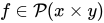
1.7.4. Tenemos también que si e son dos conjuntos, y si es cualquier función de en , entonces , y así . Luego, si es el conjunto de todas las funciones , , de modo que .
1.7.5. Sea un conjunto cualquiera, y sea . Claramente .
1.7.6. Sea un conjunto. La función
,
que envía un elemento de con un subconjunto de , se denomina familia de subconjuntos de indicada por . El conjunto se denomina en este caso conjunto de índices (por lo que cada se dice un índice), y la imagen de cualquier por medio de esta función se representa por .
Por ejemplo, considérese el conjunto
,
y el conjunto de índices . Existen varias familias de subconjuntos de indicadas por . Una de estas puede ser la función
,
dada por
.
Otra puede ser la que viene dada por
.
1.7.7. Sea la función de un conjunto en otro ;
Si
(F-3) para cualesquiera y implica ,
es decir, si cualesquiera distintos elementos de tienen distintas imágenes en , se dice que es una función inyectiva o que es una inyección.
Si
(F-4) para todo existe tal que ,
es decir, si (i.e. si todo es imagen), se dice que es una función sobreyectiva (o suprayectiva), que es una función de sobre, o que es una sobreyección.
(F-5) Una función que es a la vez inyectiva y sobreyectiva se dice función biyectiva o biyección.
1.7.8. Sea , y sea un subconjunto de (i.e. un elemento de ). El conjunto dado por
existe tal que ,
se dice imagen del subconjunto por . Es decir, es el conjunto de todos los que son imagen de algún elemento de . Así pues,
y, en particular,
.
Nótese que, si , entonces
es un conjunto con un solo elemento, a saber, la imagen de por .
1.7.9. Por otra parte, si , entonces se define el conjunto por
,
y se llama a este conjunto imagen recíproca de por . Así pues,
.
Puesto que todo elemento de tiene una imagen en , tenemos que, como caso particular,
.
Sin embargo, debemos tener presente que, si bien , donde , siempre es un conjunto con un solo elemento, el conjunto con puede ser vacío, ya que la definición de función no garantiza que todo elemento de tenga un antecedente en . Sin embargo esto si esta garantizado cuando es sobreyectiva, de modo que, en ese caso, el conjunto
contiene cualquier elemento de cuya imagen sea . Si es además inyectiva, entonces es biyectiva, de modo que es la imagen de solo un elemento de , y así contiene solo a tal elemento .
1.7.10. Veamos ahora algunas propiedades generales de las funciones. Para esto definimos una función y dos familias e de subconjuntos de e respectivamente. Convenimos también en que , e , representan, respectivamente, subconjuntos de y subconjuntos de .
Tenemos que
(a) implica .
Demostración: Sea pues . Si , entonces, por definición (véase ¿?), existe tal que , pero en tal caso , pues , de modo que . QED
(b) implica .
Demosracón: Si , entonces , puesto que , se tiene , luego , y así . QED
(c) .
Demostración: Sea . La imagen de por , , está en el conjunto , y así . QED
Si, en particular, la función es inyectiva, entonces
(d) .
(e) .
Demostración: Si , entonces es la imagen de algún , y así . QED
Si, en particular, es sobreyectiva, entonces
(f) .
(g) implica .
Demostración: En vista de (d), solo queda demostrar que, si , entonces . Esto es fácil considerando que solo contiene elementos que son imágenes, y por tanto esto también es cierto para , de modo que si , , luego , con lo que la prueba termina. QED
(h)] .
Demostración: Sea . Así, existe tal que , pero en ese caso , de modo que , y con esto . Solo falta demostrar que , lo que consiste de seguir los pasos anteriores en el sentido opuesto. QED
Si, en particular, es inyectiva, se cumple
(i) .
Demostración: Sea . Entonces, puesto que es inyectiva, existe un único tal que . Luego, , de modo que , y así . QED
Debemos hacer énfasis en que el resultado anterior no se cumple para cualquier función a menos que esta sea inyectiva. Por ejemplo, si no es inyectiva, puede ser , pero esto no es suficiente para garantizar que , por que al no ser inyectiva, podría existir un tal que , caso en el cual la imagen de está en por que es la misma imagen de un elemento que si esta en .
Si, en particular, la función es sobreyectiva, tenemos
(j) .
Demostración: Si , tenemos que , por lo que no tiene ningún antecedente en . Notemos que, por ser una sobreyección, tiene por lo menos un antecedente en . Sea cualquiera de estos antecedentes de , es decir, sea . Tenemos que , por lo que , lo que demuestra lo que se quería. QED
Si la función es biyectiva (es decir, si es tanto inyectiva como sobreyectiva), se cumple, en vista de (h) e (i), lo siguiente
(k) .
1.7.11. Sea una familia de subconjuntos de un conjunto . Es común llamar simplemente unión de a la unión de los conjuntos del rango de , que se representa por y que se define (véase 1.3.4) naturalmente por
.
1.7.12. Sea una función . Se cumplen:
(a) .
Demostración: Si , entonces existe al menos un tal que , y de esta manera , y con ello , para almenos un . Así, , lo que demuestra . Invertir todos los pasos de esta prueba para demostrar que se deja como ejercicio para el lector. QED
(b) .
La demostración se deja como ejercicio para el lector.
1.7.13. Por otra parte, la intersección de los conjuntos del rango de la familia , que se representa por , se dice simplemente intersección de . Así pues (véase 1.3.5),
.
1.7.14. Sea una función . Se cumplen
(a) .
Demostración: Sea . Entonces existe tal que , con para todo índice . Por esta razón, para todo , con lo que . QED
(b) .
Demostración: Si , es el antecedente de un único , es decir, . Pero si , entonces para todo índice . Así para todo , luego . Esto demuestra que . Demostrar que se deja como ejercicio al lector. QED
Si la función es además inyectiva, se cumple
(c) .
Demostración: En vista de (a), solo queda demostrar que, en caso de que sea inyectiva, . Para esto, sea , de manera que para todo índice . Puesto que es inyectiva, no es imagen más que de un único elemento a, y que, al ser para todo índice , cumple con para todo , con lo que . Así , lo que demuestra lo que se quería. QED
Resaltamos que el enunciado (c) se cumple solo en caso de que la función sea inyectiva. La razón es que un elemento puede no estar en para todo , y sin embargo, puede que su imagen si esté en todos los conjuntos debido a que es la imagen de algún otro elemento contenido en los conjuntos que no tienen a . Por ejemplo, supóngase , cuya imagen es , no está en para algún , pero que este conjunto contiene otro elemento cuya imagen es también , de tal manera que para cualquiera que sea el índice sin necesidad de que para todo . En ese caso (cuando es no inyectiva) tenemos
.
1.7.15. La función dada por
para todo , y que por tanto envía cada elemento de consigo mismo, se llama función identidad.
Es claro que, siendo ,
y .
Si , esto se reduce a
.
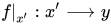
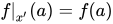
1.7.16. Sean e dos conjuntos y considérese una función . Sea un subconjunto de . La función dada por
,
se dice restricción de a . Esto es,
,
por lo que la restricción de a es una función que resulta de 'recortar' el dominio de . Es claro que .
1.7.17. Sea un conjunto y un subconjunto de . La aplicación
dada por
,
e.i. la restricción , se llama inyección canónica de en x.
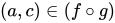
1.7.18. Sea una aplicación de un conjunto en otro , y sea una aplicación de en un conjunto . La aplicación
dada por
se dice composición de y . Esto es, resulta de aplicar seguida de , por lo que si envía un elemento con un elemento y envía a con un elemento , entonces envía directamente el elemento con el elemento (Refiérase a la figura de abajo).
1.7.19. Sean las funciones , y . Tenemos que . Para convencernos de ello es suficiente ver que
y que
.
1.7.20 Si es una función biyectiva, puede definirse la función , llamada función inversa de , por
si y solo si .
Es decir,
si y solo si .
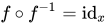
1.7.21 Es inmediato que
.
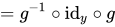
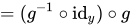
1.7.22. Además, se observa que
y
,
por lo que
y .
Si , esto se simplifica a
.
1.7.23. Nótese también que, siendo ,
.
1.7.24. Es claro que existe cuando es biyectiva. Además la función inversa de una función es única. Para probar esto, supóngase que y son dos funciones inversas de una función . Entonces
,
y
,
y por tanto .
1.7.25. Sean las funciones y . Entonces
.
En efecto, pues es función inversa de , y
con lo que es también función inversa de , y así y han de ser la misma función (pues la inversa de cualquier función es única). Otra forma de demostrar que es el argumento siguiente: Sea . Se sigue que , y de esto que para un tal que , o sea que y , de modo que y , y por tanto . Esto prueba que , y probar que resulta de recorrer todos los pasos anteriores de forma invertida.
1.8.1. Sean los conjuntos e . Cualquier subconjunto se dice relación de sobre . Por tanto, una relación es un conjunto de pares ordenados, de modo que toda función es una relación, si bien lo recíproco no es necesariamente cierto, pues puede una relación no cumplir (f-1) o (f-2) (o ambas) de 1.7.1 . De ésto, resulta conveniente adoptar una notación diferente a la que se usó con las funciones para expresar el hecho de que . Así pues, escribiremos
,
y cuando . Para el caso particular en que es una relación que es a su vez es función, tenemos
.
Sin embargo, emplearemos la notación para representar cuando sepamos que es una función.
1.8.2. Las relaciones pueden definirse entre más de dos conjuntos. Así, una relación entre los conjuntos , y , puede ser cualquier subconjunto del producto cartesiano , y consistiría por tanto de ternas ordenadas. Una relación así se dice relación ternaria, para distinguirse de las relaciones que se aplican solo entre dos conjuntos (que naturalmente se llaman relaciones binarias). En términos más generales, una función -aria entre cuales quiera conjuntos , es un conjunto cualquiera .
1.8.3. En este libro solo trataremos las relaciones binarias, por lo que cuando se hable de relación se entenderá que se trata de una de éstas.
1.8.4. En particular, una relación sobre un conjunto es un subconjunto . Al igual que las funciones, las relaciones sobre un conjunto pueden tener, de forma particular, ciertas propiedades que permiten clasificarlas. Más exactamente: Sea una relación sobre un conjunto .
La relación es reflexiva siempre que
( R-1 ) para toda .
La relación es irreflexiva si
( R-2 ) para ningún .
La relación es simétrica siempre que
(R-3) y a para cualesquiera .
La relación es antisimétrica siempre que
(R-4) y implica para cualesquiera .
La relación es asimétrica siempre que
(R-5) implica que a es falso para cualesquiera .
La relación es transitiva siempre que
(R-6) y implica para cualesquiera .
La relación es conexa siempre que
(R-7) o para cualesquiera .
1.8.5. Una relación que es reflexiva, simétrica y transitiva se dice relación de equivalencia. Si es una relación de equivalencia sobre un conjunto y si , entonces el conjunto dado por
se dice clase de equivalencia de por . Si se sabe cual es la relación y si no se presta a confusión, es común escribir simplemente en lugar de . Así pues
.
1.8.6. La aplicación identidad en un conjunto ,
,
es claramente una relación de equivalencia sobre , y dentro del contexto de la teoría de relaciones suele hacerse referencia a ella mediante el término relación trivial.
1.8.7. Otra relación de equivalencia sobre un conjunto es el mismo producto cartesiano , que en este caso se llama comúnmente relación grosera.
1.8.8. Puesto que una relación de equivalencia sobre un conjunto es reflexiva, tenemos
para todo . Además, es simétrica, de donde
.
Se tiene también que
.
Efectivamente, pues si , entonces y , y por simetría, , luego por transitividad . Otra cosa más es que
.
La razón es que si , entonces existe un tal que y o sea que y , y con esto , que como ya vimos significa que .
1.8.9. Otra forma de expresear este resultado es que
.
1.8.10. Sea una relación de equivalencia sobre un conjunto . El conjunto cociente de por la relación , que se representa por , se define por
.
Es decir, contiene todas las clases de equivalencia por la relación .
1.8.11. Puesto que cada uno de los elementos de está en alguna clase de equivalencia (pues por ejemplo si se tiene ), resulta que
,
o, para mayor claridad,
,
y como cualesquiera dos clases de equivalencia distintas de son disjuntas (véase 1.8.9), es una partición de (véase 1.5.6).
1.8.12. Sea una partición de un conjunto . Luego defínase la relación mediante
para algún . Puesto que
,
cada uno de los elementos de está contenido en algún conjunto de , por lo que para todo , y así es reflexiva. Claramente implica para todo , por lo que es simétrica. Además, si y , existen tales que y , y estos han de cumplir (pues si , ha de ser , lo que es contradictorio en vista de que y ), y entonces concluimos que . Esto hace que sea también transitiva, y entonces termina siendo esta una relación de equivalencia sobre inducida por la partición .
1.8.13. El resultado de 1.8.11 y el resultado de 1.8.12 se resumen en el enunciado siguiente:
Si es una relación de equivalencia sobre un conjunto , entonces el conjunto cociente es una partición de y, recíprocamente, si es una partición del conjunto , entonces existe una relación tal que .
1.8.14. Una relación sobre un conjunto reflexiva, antisimétrica y transitiva se dice relación de orden parcial (o simplemente un orden) sobre el conjunto , y el par se dice entonces un conjunto parcialmente ordenado, o simplemente que es un conjunto ordenado.
1.8.15. Aquí usaremos el símbolo
para representar un orden parcial cualquiera (diferente según el contexto) y no solo para el familiar orden sobre el conjunto de números reales.
En particular, la relación de inclusión sobre el conjunto potencia de un conjunto es una relación de orden parcial.
1.8.16. Se dice que es una relación de orden (parcial) estricto, o simplemente que es un orden estricto, sobre un conjunto , si es irreflexiva, antisimétrica y transitiva. Para representar ordenes estrictos, cualesquiera que sean estos, usaremos el símbolo
.
Un orden que no sea estricto será llamado simplemente orden no estricto.
1.8.17. Si es una relación de orden no estricto sobre un conjunto , entonces la relación
es claramente un orden estricto sobre . Por otro lado, si es una relación de orden estricto sobre , entonces
es una relación de orden no estricto sobre .
1.8.18. Sea un conjunto ordenado. Un elemento tal que para todo se dice elemento mínimo (o primer elemento) de . El elemento mínimo de un conjunto, si existe, es único. En efecto, pues si y fueran dos elementos mínimos de , por definición
,
y por antisimetría, .
1.8.19. Sea un conjunto ordenado. Un elemento tal que para todo se dice elemento máximo (o último elemento) de . También el elemento máximo de un conjunto, si existe, es único.
1.8.20. En un conjunto ordenado es posible que existan elementos que, pudiendo no ser un máximo o un mínimo de , tienen cierta distinción sobre otros elementos de por medio de el orden . Nos referimos a los minimales y los maximales. Un elemento es un minimal en si no existe ningún elemento en estrictamente menor que . (por medio del orden estricto dado por si y solo si y , por supuesto) ; un elemento se dice máximal de si no existe ningún elemento en estrictamente mayor que . Es posible que los minimales de un conjunto, si existen, sean más de uno. Lo mismo aplica para los maximales de un conjunto.
Notemos pues que un conjunto puede no contener ni mínimos (máximos) ni minimales (maximales), o bien, contener uno o más minimales (maximales) y ningún mínimo (máximo). Si un conjunto tiene mínimo (máximo), éste es a su vez el único minimal (maximal) del conjunto.
1.8.21. Sea un conjunto ordenado, y sea . Un elemento tal que para todo se dice cota inferior (o minorante) de . Por otro lado, un elemento tal que para todo se dice cota superior (o mayorante) de . Una cota inferior o superior de puede o no estar en . Además, si es el conjunto de cotas inferiores de , entonces solo puede ser vacío o ser un conjunto con un solo elemento. Si , entonces el único elemento de es claramente un mínimo de . Si contiene un elemento máximo, entonces este se dice ínfimo de , y lo representaremos por . Análogamente, si es el conjunto de todas las cotas superiores de , o contiene a lo más un elemento, el cual sería entonces un máximo de . Si tiene un mínimo, entonces este se dice supremo de , y lo representaremos por .
1.8.22. Un conjunto que tiene cotas inferiores se dice inferiormente acotado, mientras que un conjunto que tiene cotas superiores se dice superiormente acotado. Si un conjunto esta acotado inferior y superiormente, se dice simplemente que es acotado.
1.8.23. Sea un conjunto parcialmente ordenado. Si todo subconjunto de admite un minimal respecto de , se dice que es una relación de orden bien fundada sobre , o que es un orden bien fundado sobre . Dado ese caso, se dice que el par es bien fundado.
1.8.24. Un hecho apreciable a cerca de órdenes bien fundados es el siguiente:
Si es un conjunto parcialmente ordenado, entonces es bien fundado si y solo si no existe una secuencia infinita tal que .
En efecto, pues si no fuera un conjunto bien fundado, entonces, si , no es un minimal, y por lo tanto existe otro elemento tal que . Este argumento es claramente válido para cualquiera que sea el número natural , por lo que se concluye que si es no bien fundado, existe una secuencia infinita descendiente . Recíprocamente, si es un conjunto ordenado tal que existe una secuencia descendiente infinita , entonces, para cualquiera que sea el elemento , existe otro tal que , de modo que no es minimal de , y con ello es no bien fundado.
1.8.25. Una relación de orden que es conexa en , se dice relación de orden total, u orden total, sobre , y se dice que el par es un conjunto totalmente ordenado.
1.8.25. Un conjunto totalmente ordenado y bien fundado se dice conjunto bien ordenado, y su relación de orden se dice por tanto un buen orden. Supóngase que es un conjunto bien ordenado. Entonces es, en particular, bien fundado, por lo que todo subconjunto tiene por lo menos un minimal. Supóngase que y son dos minimales de . Puesto que es totalmente ordenado,
.
Cualquiera que sea el caso, debe de ser , pues si no, o , lo que no puede ser por que un minimal no tiene un elemento estrictamente menor que él (ni siquiera siendo este otro minimal). Vemos entonces que el elemento minimal es un mínimo de . Por conclusión, un conjunto ordenado es bien ordenado si todo subconjunto de tiene mínimo.
1. Supóngase dado el conjunto de los números naturales, que representaremos por . Escribir el conjunto en notación de la forma .
2. Probar que, siendo el conjunto de los números enteros, .
GNU Free Documentation License
Version 1.2, November 2002
Copyright (C) 2000,2001,2002  Free Software Foundation, Inc.
51 Franklin St, Fifth Floor, Boston, MA  02110-1301  USA
Everyone is permitted to copy and distribute verbatim copies
of this license document, but changing it is not allowed.
0. PREAMBLE
The purpose of this License is to make a manual, textbook, or other functional and useful document "free" in the sense of freedom: to assure everyone the effective freedom to copy and redistribute it, with or without modifying it, either commercially or noncommercially. Secondarily, this License preserves for the author and publisher a way to get credit for their work, while not being considered responsible for modifications made by others.
This License is a kind of "copyleft", which means that derivative works of the document must themselves be free in the same sense. It complements the GNU General Public License, which is a copyleft license designed for free software.
We have designed this License in order to use it for manuals for free software, because free software needs free documentation: a free program should come with manuals providing the same freedoms that the software does. But this License is not limited to software manuals; it can be used for any textual work, regardless of subject matter or whether it is published as a printed book. We recommend this License principally for works whose purpose is instruction or reference.
1. APPLICABILITY AND DEFINITIONS
This License applies to any manual or other work, in any medium, that contains a notice placed by the copyright holder saying it can be distributed under the terms of this License. Such a notice grants a world-wide, royalty-free license, unlimited in duration, to use that work under the conditions stated herein. The "Document", below, refers to any such manual or work. Any member of the public is a licensee, and is addressed as "you". You accept the license if you copy, modify or distribute the work in a way requiring permission under copyright law.
A "Modified Version" of the Document means any work containing the Document or a portion of it, either copied verbatim, or with modifications and/or translated into another language.
A "Secondary Section" is a named appendix or a front-matter section of the Document that deals exclusively with the relationship of the publishers or authors of the Document to the Document's overall subject (or to related matters) and contains nothing that could fall directly within that overall subject. (Thus, if the Document is in part a textbook of mathematics, a Secondary Section may not explain any mathematics.) The relationship could be a matter of historical connection with the subject or with related matters, or of legal, commercial, philosophical, ethical or political position regarding them.
The "Invariant Sections" are certain Secondary Sections whose titles are designated, as being those of Invariant Sections, in the notice that says that the Document is released under this License. If a section does not fit the above definition of Secondary then it is not allowed to be designated as Invariant. The Document may contain zero Invariant Sections. If the Document does not identify any Invariant Sections then there are none.
The "Cover Texts" are certain short passages of text that are listed, as Front-Cover Texts or Back-Cover Texts, in the notice that says that the Document is released under this License. A Front-Cover Text may be at most 5 words, and a Back-Cover Text may be at most 25 words.
A "Transparent" copy of the Document means a machine-readable copy, represented in a format whose specification is available to the general public, that is suitable for revising the document straightforwardly with generic text editors or (for images composed of pixels) generic paint programs or (for drawings) some widely available drawing editor, and that is suitable for input to text formatters or for automatic translation to a variety of formats suitable for input to text formatters. A copy made in an otherwise Transparent file format whose markup, or absence of markup, has been arranged to thwart or discourage subsequent modification by readers is not Transparent. An image format is not Transparent if used for any substantial amount of text. A copy that is not "Transparent" is called "Opaque".
Examples of suitable formats for Transparent copies include plain ASCII without markup, Texinfo input format, LaTeX input format, SGML or XML using a publicly available DTD, and standard-conforming simple HTML, PostScript or PDF designed for human modification. Examples of transparent image formats include PNG, XCF and JPG. Opaque formats include proprietary formats that can be read and edited only by proprietary word processors, SGML or XML for which the DTD and/or processing tools are not generally available, and the machine-generated HTML, PostScript or PDF produced by some word processors for output purposes only.
The "Title Page" means, for a printed book, the title page itself, plus such following pages as are needed to hold, legibly, the material this License requires to appear in the title page. For works in formats which do not have any title page as such, "Title Page" means the text near the most prominent appearance of the work's title, preceding the beginning of the body of the text.
A section "Entitled XYZ" means a named subunit of the Document whose title either is precisely XYZ or contains XYZ in parentheses following text that translates XYZ in another language. (Here XYZ stands for a specific section name mentioned below, such as "Acknowledgements", "Dedications", "Endorsements", or "History".) To "Preserve the Title" of such a section when you modify the Document means that it remains a section "Entitled XYZ" according to this definition.
The Document may include Warranty Disclaimers next to the notice which states that this License applies to the Document. These Warranty Disclaimers are considered to be included by reference in this License, but only as regards disclaiming warranties: any other implication that these Warranty Disclaimers may have is void and has no effect on the meaning of this License.
2. VERBATIM COPYING
You may copy and distribute the Document in any medium, either commercially or noncommercially, provided that this License, the copyright notices, and the license notice saying this License applies to the Document are reproduced in all copies, and that you add no other conditions whatsoever to those of this License. You may not use technical measures to obstruct or control the reading or further copying of the copies you make or distribute. However, you may accept compensation in exchange for copies. If you distribute a large enough number of copies you must also follow the conditions in section 3.
You may also lend copies, under the same conditions stated above, and you may publicly display copies.
3. COPYING IN QUANTITY
If you publish printed copies (or copies in media that commonly have printed covers) of the Document, numbering more than 100, and the Document's license notice requires Cover Texts, you must enclose the copies in covers that carry, clearly and legibly, all these Cover Texts: Front-Cover Texts on the front cover, and Back-Cover Texts on the back cover. Both covers must also clearly and legibly identify you as the publisher of these copies. The front cover must present the full title with all words of the title equally prominent and visible. You may add other material on the covers in addition. Copying with changes limited to the covers, as long as they preserve the title of the Document and satisfy these conditions, can be treated as verbatim copying in other respects.
If the required texts for either cover are too voluminous to fit legibly, you should put the first ones listed (as many as fit reasonably) on the actual cover, and continue the rest onto adjacent pages.
If you publish or distribute Opaque copies of the Document numbering more than 100, you must either include a machine-readable Transparent copy along with each Opaque copy, or state in or with each Opaque copy a computer-network location from which the general network-using public has access to download using public-standard network protocols a complete Transparent copy of the Document, free of added material. If you use the latter option, you must take reasonably prudent steps, when you begin distribution of Opaque copies in quantity, to ensure that this Transparent copy will remain thus accessible at the stated location until at least one year after the last time you distribute an Opaque copy (directly or through your agents or retailers) of that edition to the public.
It is requested, but not required, that you contact the authors of the Document well before redistributing any large number of copies, to give them a chance to provide you with an updated version of the Document.
4. MODIFICATIONS
You may copy and distribute a Modified Version of the Document under the conditions of sections 2 and 3 above, provided that you release the Modified Version under precisely this License, with the Modified Version filling the role of the Document, thus licensing distribution and modification of the Modified Version to whoever possesses a copy of it. In addition, you must do these things in the Modified Version:
A. Use in the Title Page (and on the covers, if any) a title distinct from that of the Document, and from those of previous versions (which should, if there were any, be listed in the History section of the Document). You may use the same title as a previous version if the original publisher of that version gives permission.
B. List on the Title Page, as authors, one or more persons or entities responsible for authorship of the modifications in the Modified Version, together with at least five of the principal authors of the Document (all of its principal authors, if it has fewer than five), unless they release you from this requirement.
C. State on the Title page the name of the publisher of the Modified Version, as the publisher.
D. Preserve all the copyright notices of the Document.
E. Add an appropriate copyright notice for your modifications adjacent to the other copyright notices.
F. Include, immediately after the copyright notices, a license notice giving the public permission to use the Modified Version under the terms of this License, in the form shown in the Addendum below.
G. Preserve in that license notice the full lists of Invariant Sections and required Cover Texts given in the Document's license notice.
H. Include an unaltered copy of this License.
I. Preserve the section Entitled "History", Preserve its Title, and add to it an item stating at least the title, year, new authors, and publisher of the Modified Version as given on the Title Page. If there is no section Entitled "History" in the Document, create one stating the title, year, authors, and publisher of the Document as given on its Title Page, then add an item describing the Modified Version as stated in the previous sentence.
J. Preserve the network location, if any, given in the Document for public access to a Transparent copy of the Document, and likewise the network locations given in the Document for previous versions it was based on. These may be placed in the "History" section. You may omit a network location for a work that was published at least four years before the Document itself, or if the original publisher of the version it refers to gives permission.
K. For any section Entitled "Acknowledgements" or "Dedications", Preserve the Title of the section, and preserve in the section all the substance and tone of each of the contributor acknowledgements and/or dedications given therein.
L. Preserve all the Invariant Sections of the Document, unaltered in their text and in their titles. Section numbers or the equivalent are not considered part of the section titles.
M. Delete any section Entitled "Endorsements". Such a section may not be included in the Modified Version.
N. Do not retitle any existing section to be Entitled "Endorsements" or to conflict in title with any Invariant Section.
O. Preserve any Warranty Disclaimers.
If the Modified Version includes new front-matter sections or appendices that qualify as Secondary Sections and contain no material copied from the Document, you may at your option designate some or all of these sections as invariant. To do this, add their titles to the list of Invariant Sections in the Modified Version's license notice. These titles must be distinct from any other section titles.
You may add a section Entitled "Endorsements", provided it contains nothing but endorsements of your Modified Version by various parties--for example, statements of peer review or that the text has been approved by an organization as the authoritative definition of a standard.
You may add a passage of up to five words as a Front-Cover Text, and a passage of up to 25 words as a Back-Cover Text, to the end of the list of Cover Texts in the Modified Version. Only one passage of Front-Cover Text and one of Back-Cover Text may be added by (or through arrangements made by) any one entity. If the Document already includes a cover text for the same cover, previously added by you or by arrangement made by the same entity you are acting on behalf of, you may not add another; but you may replace the old one, on explicit permission from the previous publisher that added the old one.
The author(s) and publisher(s) of the Document do not by this License give permission to use their names for publicity for or to assert or imply endorsement of any Modified Version.
5. COMBINING DOCUMENTS
You may combine the Document with other documents released under this License, under the terms defined in section 4 above for modified versions, provided that you include in the combination all of the Invariant Sections of all of the original documents, unmodified, and list them all as Invariant Sections of your combined work in its license notice, and that you preserve all their Warranty Disclaimers.
The combined work need only contain one copy of this License, and multiple identical Invariant Sections may be replaced with a single copy. If there are multiple Invariant Sections with the same name but different contents, make the title of each such section unique by adding at the end of it, in parentheses, the name of the original author or publisher of that section if known, or else a unique number. Make the same adjustment to the section titles in the list of Invariant Sections in the license notice of the combined work.
In the combination, you must combine any sections Entitled "History" in the various original documents, forming one section Entitled "History"; likewise combine any sections Entitled "Acknowledgements", and any sections Entitled "Dedications". You must delete all sections Entitled "Endorsements."
6. COLLECTIONS OF DOCUMENTS
You may make a collection consisting of the Document and other documents released under this License, and replace the individual copies of this License in the various documents with a single copy that is included in the collection, provided that you follow the rules of this License for verbatim copying of each of the documents in all other respects.
You may extract a single document from such a collection, and distribute it individually under this License, provided you insert a copy of this License into the extracted document, and follow this License in all other respects regarding verbatim copying of that document.
7. AGGREGATION WITH INDEPENDENT WORKS
A compilation of the Document or its derivatives with other separate and independent documents or works, in or on a volume of a storage or distribution medium, is called an "aggregate" if the copyright resulting from the compilation is not used to limit the legal rights of the compilation's users beyond what the individual works permit. When the Document is included in an aggregate, this License does not apply to the other works in the aggregate which are not themselves derivative works of the Document.
If the Cover Text requirement of section 3 is applicable to these copies of the Document, then if the Document is less than one half of the entire aggregate, the Document's Cover Texts may be placed on covers that bracket the Document within the aggregate, or the electronic equivalent of covers if the Document is in electronic form. Otherwise they must appear on printed covers that bracket the whole aggregate.
8. TRANSLATION
Translation is considered a kind of modification, so you may distribute translations of the Document under the terms of section 4. Replacing Invariant Sections with translations requires special permission from their copyright holders, but you may include translations of some or all Invariant Sections in addition to the original versions of these Invariant Sections. You may include a translation of this License, and all the license notices in the Document, and any Warranty Disclaimers, provided that you also include the original English version of this License and the original versions of those notices and disclaimers. In case of a disagreement between the translation and the original version of this License or a notice or disclaimer, the original version will prevail.
If a section in the Document is Entitled "Acknowledgements", "Dedications", or "History", the requirement (section 4) to Preserve its Title (section 1) will typically require changing the actual title.
9. TERMINATION
You may not copy, modify, sublicense, or distribute the Document except as expressly provided for under this License. Any other attempt to copy, modify, sublicense or distribute the Document is void, and will automatically terminate your rights under this License. However, parties who have received copies, or rights, from you under this License will not have their licenses terminated so long as such parties remain in full compliance.
10. FUTURE REVISIONS OF THIS LICENSE
The Free Software Foundation may publish new, revised versions of the GNU Free Documentation License from time to time. Such new versions will be similar in spirit to the present version, but may differ in detail to address new problems or concerns. See http://www.gnu.org/copyleft/.
Each version of the License is given a distinguishing version number. If the Document specifies that a particular numbered version of this License "or any later version" applies to it, you have the option of following the terms and conditions either of that specified version or of any later version that has been published (not as a draft) by the Free Software Foundation. If the Document does not specify a version number of this License, you may choose any version ever published (not as a draft) by the Free Software Foundation.





































































































![{\displaystyle f\left[x_{1}\right]=\{b\in y\mid }](https://wikimedia.org/api/rest_v1/media/math/render/svg/684373f513b69cabcbdb07de51f922eddf1ef2cc)


![{\displaystyle f\left[x_{1}\right]}](https://wikimedia.org/api/rest_v1/media/math/render/svg/3647523017767c224056907e3ba23c6698bb746e)
![{\displaystyle f\left[x_{1}\right]\subseteq \mathrm {ran} (f)}](https://wikimedia.org/api/rest_v1/media/math/render/svg/1f6c4a9645fad89755335cc42633a2a0875bea43)
![{\displaystyle f\left[x\right]=\mathrm {ran} (f)}](https://wikimedia.org/api/rest_v1/media/math/render/svg/24590822b13e7286080b2bf91bd71acb7d0e621f)
![{\displaystyle f\left[\{a\}\right]=\{f(a)\}}](https://wikimedia.org/api/rest_v1/media/math/render/svg/b95321cfa6e52177bb554981d7777f1a50777f8b)

![{\displaystyle f^{-1}\left[y_{1}\right]}](https://wikimedia.org/api/rest_v1/media/math/render/svg/fcde7f7f6e9cd506fc6843a151c0bd1afc1b884c)
![{\displaystyle f^{-1}\left[y_{1}\right]=\{a\in x\mid f(a)\in y_{1}\}}](https://wikimedia.org/api/rest_v1/media/math/render/svg/95420fac1cd7c665a5d62152d9f4a0cdb5c5a66f)

![{\displaystyle f^{-1}\left[y_{1}\right]\subseteq x}](https://wikimedia.org/api/rest_v1/media/math/render/svg/e3361a135fd24b20386924cae5935e7cc8bd7046)
![{\displaystyle f^{-1}\left[y\right]=x}](https://wikimedia.org/api/rest_v1/media/math/render/svg/ad024d37d2dce144fed4cf84674719eab7cc4ed4)
![{\displaystyle f\left[\{a\}\right]}](https://wikimedia.org/api/rest_v1/media/math/render/svg/77632fc84578ac00cd849da77b1421bfd0456fc7)
![{\displaystyle f^{-1}\left[\{b\}\right]}](https://wikimedia.org/api/rest_v1/media/math/render/svg/d2114d4d4b2971a4050b2d83cb8a91718564016d)


![{\displaystyle f\left[x_{1}\right]\subseteq f\left[x_{2}\right]}](https://wikimedia.org/api/rest_v1/media/math/render/svg/e71957c1c706ace8497b40d9a8c5c2ee0ec0a93f)
![{\displaystyle b\in f\left[x_{1}\right]}](https://wikimedia.org/api/rest_v1/media/math/render/svg/4428c35079afb3afb82e4aa7b6a6316c59057aeb)

![{\displaystyle b\in f\left[x_{2}\right]}](https://wikimedia.org/api/rest_v1/media/math/render/svg/ef4605f270346c4e7ffcffebac6d94393a1fb76b)

![{\displaystyle f^{-1}\left[y_{1}\right]\subseteq f^{-1}\left[y_{2}\right]}](https://wikimedia.org/api/rest_v1/media/math/render/svg/d38a8da80e4daf4c5c6cd811f6b8b15ec9d31ee8)
![{\displaystyle a\in f^{-1}\left[y_{1}\right]}](https://wikimedia.org/api/rest_v1/media/math/render/svg/bce5867f4378ee57fac61477f826a1dc7c6adf7e)


![{\displaystyle a\in f^{-1}\left[y_{2}\right]}](https://wikimedia.org/api/rest_v1/media/math/render/svg/a20a72521df902bef2b77bd85a34b19c5fcce048)
![{\displaystyle x_{1}\subseteq f^{-1}\left[f\left[x_{1}\right]\right]}](https://wikimedia.org/api/rest_v1/media/math/render/svg/737ddb2da070390e46bf8bff752801245fafdabe)
![{\displaystyle a\in f^{-1}\left[f\left[x_{1}\right]\right]}](https://wikimedia.org/api/rest_v1/media/math/render/svg/913330c603f76b3b058948edfa17b99c62fc9e24)
![{\displaystyle x_{1}=f^{-1}\left[f\left[x_{1}\right]\right]}](https://wikimedia.org/api/rest_v1/media/math/render/svg/2dd47012a0234ef23b7c0efe51e4341cfc2e61fe)
![{\displaystyle f\left[f^{-1}\left[y_{1}\right]\right]\subseteq y_{1}}](https://wikimedia.org/api/rest_v1/media/math/render/svg/a3658aeb9f8ebe3b0bebb6173421834a6b011ba0)
![{\displaystyle b\in f\left[f^{-1}\left[y_{1}\right]\right]}](https://wikimedia.org/api/rest_v1/media/math/render/svg/cc9a7c08e05d895ad1560a420916de166dbc8a86)

![{\displaystyle f\left[f^{-1}\left[y_{1}\right]\right]=y_{1}}](https://wikimedia.org/api/rest_v1/media/math/render/svg/223f0e99c2a507530d0d9a2d985643ead62dfb30)
![{\displaystyle y_{1}\subseteq f\left[x_{1}\right]}](https://wikimedia.org/api/rest_v1/media/math/render/svg/cdb0b461511a1769f21de37c159a276d7b4cef3b)
![{\displaystyle y_{1}\subseteq f\left[f^{-1}\left[y_{1}\right]\right]}](https://wikimedia.org/api/rest_v1/media/math/render/svg/ad1b79546012da553cb06b1332afa01bb3bd951c)
![{\displaystyle f(a)\in f\left[f^{-1}\left[y_{1}\right]\right]}](https://wikimedia.org/api/rest_v1/media/math/render/svg/9a024a43fddd46a904aff0a53014ac6e4ce95393)
![{\displaystyle f^{-1}\left[{\mathcal {C}}_{y}y_{1}\right]={\mathcal {C}}_{x}f^{-1}\left[y_{1}\right]}](https://wikimedia.org/api/rest_v1/media/math/render/svg/8db5cbd92ef5ab083679d989c4e6877364f7a240)
![{\displaystyle a\in f^{-1}\left[{\mathcal {C}}_{y}y_{1}\right]}](https://wikimedia.org/api/rest_v1/media/math/render/svg/e66087cba0291d568e9c0b3ec40970b06415dde4)


![{\displaystyle a\notin f^{-1}\left[y_{1}\right]}](https://wikimedia.org/api/rest_v1/media/math/render/svg/5a0bb8bf7cd556b192ab764e9a5e43c14ac7337e)
![{\displaystyle a\in {\mathcal {C}}_{x}f^{-1}\left[y_{1}\right]}](https://wikimedia.org/api/rest_v1/media/math/render/svg/ffd85dd461bee6a88f6edc5cda41530943838036)
![{\displaystyle {\mathcal {C}}_{x}f^{-1}\left[y_{1}\right]\subseteq f^{-1}\left[{\mathcal {C}}_{y}y_{1}\right]}](https://wikimedia.org/api/rest_v1/media/math/render/svg/5af1d5eec4112cc71d36feb8341e525a987d680b)
![{\displaystyle f\left[{\mathcal {C}}_{x}x_{1}\right]\subseteq {\mathcal {C}}_{y}f\left[x_{1}\right]}](https://wikimedia.org/api/rest_v1/media/math/render/svg/748f4ef498602f107dc06457fa1458196cd4edfa)
![{\displaystyle b\in f\left[{\mathcal {C}}_{x}x_{1}\right]}](https://wikimedia.org/api/rest_v1/media/math/render/svg/b89d21df485af17f879529c1767382bd87f3d464)


![{\displaystyle b\notin f\left[x_{1}\right]}](https://wikimedia.org/api/rest_v1/media/math/render/svg/c216dbb3df7129b977f0695ea0d910b7dc63bd63)
![{\displaystyle b\in {\mathcal {C}}_{y}f\left[x_{1}\right]}](https://wikimedia.org/api/rest_v1/media/math/render/svg/9faf48bc3b15a47a03d1a77e88ea4e01cfa34e64)
![{\displaystyle f(a)\notin f\left[x_{1}\right]}](https://wikimedia.org/api/rest_v1/media/math/render/svg/ad51d39dad1306a350437e2bd6f8beae28c45877)


![{\displaystyle {\mathcal {C}}_{y}f\left[x_{1}\right]\subseteq f\left[{\mathcal {C}}_{x}x_{1}\right]}](https://wikimedia.org/api/rest_v1/media/math/render/svg/059b5e86705195a22ba0cc5b93ed23507374b6de)
![{\displaystyle f\left[{\mathcal {C}}_{x}x_{1}\right]={\mathcal {C}}_{y}f\left[x_{1}\right]}](https://wikimedia.org/api/rest_v1/media/math/render/svg/2526056a47314cd406e02809c88836b53c97e922)


![{\displaystyle f\left[\bigcup _{i\in I}x_{i}\right]=\bigcup _{i\in I}f[x_{i}]}](https://wikimedia.org/api/rest_v1/media/math/render/svg/aa4359a3f4d79fbf78820ef2a5eb351cfa260795)
![{\displaystyle b\in f\left[\bigcup _{i\in I}x_{i}\right]}](https://wikimedia.org/api/rest_v1/media/math/render/svg/e741cc3a96d9dda4edda9d421955e8db7c4fd108)


![{\displaystyle b\in f\left[x_{i}\right]}](https://wikimedia.org/api/rest_v1/media/math/render/svg/ef0b370099dc9515a3ad21d2f74c198f522a9af7)
![{\displaystyle b\in \bigcup _{x\in I}f\left[x_{i}\right]}](https://wikimedia.org/api/rest_v1/media/math/render/svg/79599b97b8929817280dd0896e9099125cb48362)
![{\displaystyle f\left[\bigcup _{i\in I}x_{i}\right]\subseteq \bigcup _{i\in I}f\left[x_{i}\right]}](https://wikimedia.org/api/rest_v1/media/math/render/svg/14a572b5987e9ecb73e66ebe2eca71cce39efd0e)
![{\displaystyle \bigcup _{i\in I}f\left[x_{i}\right]\subseteq f\left[\bigcup _{i\in I}x_{i}\right]}](https://wikimedia.org/api/rest_v1/media/math/render/svg/a05cd854a3fd22fb1b0cc388176f9dc30a8c9cac)
![{\displaystyle f^{-1}\left[\bigcup _{i\in I}y_{i}\right]=\bigcup _{i\in I}f^{-1}[y_{i}]}](https://wikimedia.org/api/rest_v1/media/math/render/svg/85de05929eb20fcd5b375de8b8dbb4f9e32f06b7)


![{\displaystyle f\left[\bigcap _{i\in I}x_{i}\right]\subseteq \bigcap _{i\in I}f\left[x_{i}\right]}](https://wikimedia.org/api/rest_v1/media/math/render/svg/016bb9813dc5b624d2d91409e24b49bff049efa7)
![{\displaystyle b\in f\left[\bigcap _{i\in I}x_{i}\right]}](https://wikimedia.org/api/rest_v1/media/math/render/svg/c5b6f79d1d10fd7cbc3d564fa5c82c9f906a756d)

![{\displaystyle b\in \bigcap _{i\in I}f\left[x_{i}\right]}](https://wikimedia.org/api/rest_v1/media/math/render/svg/aa953853da4004b00c7afae1666a56b147c0e7f0)
![{\displaystyle f^{-1}\left[\bigcap _{i\in I}y_{i}\right]=\bigcap _{i\in I}f^{-1}\left[y_{i}\right]}](https://wikimedia.org/api/rest_v1/media/math/render/svg/282d8532f39db6c72240f0c87599c3f55bfd6219)
![{\displaystyle a\in f^{-1}\left[\bigcap _{i\in I}y_{i}\right]}](https://wikimedia.org/api/rest_v1/media/math/render/svg/8c0cb2d09627464c47afd9cce8026339d717cdd4)


![{\displaystyle a\in f^{-1}\left[y_{i}\right]}](https://wikimedia.org/api/rest_v1/media/math/render/svg/0952bb1059b84046e1b21c175f7d4556efa38244)
![{\displaystyle a\in \bigcap _{i\in I}f^{-1}\left[y_{i}\right]}](https://wikimedia.org/api/rest_v1/media/math/render/svg/e1b202a225d951a6c132f6b9efca3eed554fccac)
![{\displaystyle f^{-1}\left[\bigcap _{i\in I}y_{i}\right]\subseteq \bigcap _{i\in I}f^{-1}\left[y_{i}\right]}](https://wikimedia.org/api/rest_v1/media/math/render/svg/94811fe9913af358e7084fd60962d6687047eda8)
![{\displaystyle \bigcap _{i\in I}f^{-1}\left[y_{i}\right]\subseteq f^{-1}\left[\bigcap _{i\in I}y_{i}\right]}](https://wikimedia.org/api/rest_v1/media/math/render/svg/c9216ecd3eff49ba50345e81c86f178fd84d3d3e)
![{\displaystyle f\left[\bigcap _{i\in I}x_{i}\right]=\bigcap _{i\in I}f\left[x_{i}\right]}](https://wikimedia.org/api/rest_v1/media/math/render/svg/71f7fa6a977a682fd5338d4523ea5f273295b555)
![{\displaystyle \bigcap _{i\in I}f\left[x_{i}\right]\subseteq f\left[\bigcap _{i\in I}x_{i}\right]}](https://wikimedia.org/api/rest_v1/media/math/render/svg/cd4d66db44069f8196f78b47b23ebb181b484ef7)
![{\displaystyle f\left[x_{i}\right]}](https://wikimedia.org/api/rest_v1/media/math/render/svg/65a183884780709fed0c42b1e779012c3bcdb9a4)
![{\displaystyle f\left[\bigcap _{i\in I}x_{i}\right]\subset \bigcap _{i\in I}f\left[x_{i}\right]}](https://wikimedia.org/api/rest_v1/media/math/render/svg/d87544f14e60a7c5b6117ff66ecabdc4c5ec3b72)








































![{\displaystyle \left[a\right]_{\mathrm {R} }}](https://wikimedia.org/api/rest_v1/media/math/render/svg/3034af820d8a6996a5071b32a4c8f4f2fe7f1078)
![{\displaystyle \left[a\right]_{\mathrm {R} }=\{b\mid b\in x\quad {\mbox{y}}\quad b\mathrm {R} a\}}](https://wikimedia.org/api/rest_v1/media/math/render/svg/9392637bd4b92c5348b0cc50ad0a977cb764f987)
![{\displaystyle \left[a\right]}](https://wikimedia.org/api/rest_v1/media/math/render/svg/76984b1ba4f30272a4b22c033dd18093f9566686)
![{\displaystyle b\in \left[a\right]_{\mathrm {R} }\quad {\mbox{si y solo si}}\quad b\mathrm {R} a}](https://wikimedia.org/api/rest_v1/media/math/render/svg/2ec82c71d920582da10f3ba1c94bdc643fb84d2a)


![{\displaystyle a\in \left[a\right]_{\mathrm {R} }}](https://wikimedia.org/api/rest_v1/media/math/render/svg/1ae9cab243b729d1b9aaaa62d8fa303f23895284)
![{\displaystyle b\in \left[a\right]_{\mathrm {R} }\quad \mathrm {si\ y\ solo\ si} \quad a\in \left[b\right]_{\mathrm {R} }}](https://wikimedia.org/api/rest_v1/media/math/render/svg/8a7142b7b3e6a587237b3f1d8e0ac8610c805cdd)
![{\displaystyle b,c\in \left[a\right]_{\mathrm {R} }\quad \mathrm {implica} \quad b\mathrm {R} c}](https://wikimedia.org/api/rest_v1/media/math/render/svg/173ed0b0076daa6dd92514fc7b66ed92385d81d7)
![{\displaystyle b,c\in \left[a\right]_{\mathrm {R} }}](https://wikimedia.org/api/rest_v1/media/math/render/svg/fd7181e84beaeef4a8bcc9f18927e640bf111f31)

![{\displaystyle \left[a\right]_{\mathrm {R} }\cap \left[b\right]_{\mathrm {R} }\neq \varnothing \quad {\mbox{implica}}\quad \left[a\right]_{\mathrm {R} }=\left[b\right]_{\mathrm {R} }}](https://wikimedia.org/api/rest_v1/media/math/render/svg/dfd7125882a999b2b93158a36db506a1ac5b4108)
![{\displaystyle \left[a\right]_{\mathrm {R} }\cap \left[b\right]_{\mathrm {R} }\neq \varnothing }](https://wikimedia.org/api/rest_v1/media/math/render/svg/2e2e11a4fec39fb7f7908cd523b693cc83111188)

![{\displaystyle c\in \left[a\right]_{\mathrm {R} }}](https://wikimedia.org/api/rest_v1/media/math/render/svg/d6d0326f120307506844cd0d66213b77107aaa33)
![{\displaystyle c\in \left[b\right]_{\mathrm {R} },}](https://wikimedia.org/api/rest_v1/media/math/render/svg/2667f3064686f91eb6b852f43e103632670af10e)

![{\displaystyle \left[a\right]_{\mathrm {R} }=\left[b\right]_{\mathrm {R} }}](https://wikimedia.org/api/rest_v1/media/math/render/svg/aecd2d84549b514cf93a25f45a54cd36a59855a0)
![{\displaystyle \left[a\right]_{\mathrm {R} }\neq \left[b\right]_{\mathrm {R} }\quad \mathrm {implica} \quad \left[a\right]_{\mathrm {R} }\cap \left[b\right]_{\mathrm {R} }=\varnothing }](https://wikimedia.org/api/rest_v1/media/math/render/svg/4c706ff66cc1632a101828f828eefbf8d4660ac4)

![{\displaystyle x/\mathrm {R} =\{\left[a\right]_{\mathrm {R} }\mid a\in x\}}](https://wikimedia.org/api/rest_v1/media/math/render/svg/ecaa94a665f14f093a489b4dab909d8f57d21103)
![{\displaystyle \bigcup _{\left[a\right]_{\mathrm {R} el}\in x/{\mathrm {R} }}\left[a\right]_{\mathrm {R} }=x}](https://wikimedia.org/api/rest_v1/media/math/render/svg/1e17206b481f04fb3a49dcca2ae5a7ec57b34df9)
![{\displaystyle \bigcup _{a\in x}\left[a\right]_{\mathrm {R} }=x}](https://wikimedia.org/api/rest_v1/media/math/render/svg/e2d59a5dc05116f1518c59b087c40283efbcbd27)